
Rockville Centre • Wantagh • Live Online
The SAT isn’t just about what students know.
It’s about how they use what they know.
Students need strong math, reading, grammar, and test-taking skills. But on the SAT, knowing something and recognizing how to use it are not always the same thing.
Rockville Centre • Wantagh • Live Online
The SAT isn’t just about what students know.
It’s about how they use what they know.
Students need strong math, reading, grammar, and test-taking skills. But on the SAT, knowing something and recognizing how to use it are not always the same thing.
Why capable students can still struggle on the SAT
For years, students are taught to prepare for tests in a familiar way: learn the material, recognize what the question is asking, and apply what you know.
On the SAT, that process is rarely straightforward.
A familiar math concept can appear in a form a student has never seen before. Two English answers can both seem reasonable. A student can have every skill needed to solve a problem and still have no idea how to begin.
That does not necessarily mean the student needs to learn more content.
Sometimes the real challenge is recognizing how to use what they already know when the path is difficult to see.
Learning to handle those moments more effectively is a major part of what we work on in class.
Knowing the strategy isn’t enough. Students have to recognize when to use it.
A student can watch a teacher solve a difficult SAT problem, understand every step, and still be left with the most important question:
“Why would I ever have thought to do that?”
That question gets at the heart of how I teach.
Instead of simply showing students how a problem is solved, we talk about what they could have noticed. What might have suggested a reasonable first step? Was there something useful they could do with the information they were given? And if there wasn’t, would it have been smarter to move on and return later?
With enough practice, something else begins to happen too.
Questions that once looked completely unfamiliar start revealing familiar structures underneath. Students begin recognizing the ways the SAT presents concepts they already know. A problem that once produced “I have no idea what this is” starts producing a very different reaction:
“I’ve seen this movie before.”
The goal is twofold: recognize more of what the SAT is doing, and make better decisions when the path still isn’t immediately clear.
Students aren’t simply collecting more strategies. They’re learning how to recognize, choose, and use them when it matters.
Confidence has to be earned.
A student gets stuck on a difficult SAT problem and brings it to class. We break down what was really happening, and suddenly the reaction is:
“Are you kidding me? I could do that. I didn’t realize that was all that was going on.”
Then it happens again.
And again.
Over time, those experiences begin changing how students react when the next difficult question appears.
Instead of immediately interpreting confusion as proof that a problem is beyond them, they have evidence from their own experience that the first impression is not always reliable.
The feeling of confusion itself isn’t reliable evidence that the problem is beyond my ability.
That kind of confidence cannot come from a pep talk. Students have to earn it through repeated successful experiences.
Understanding
↓
Successful experiences
↓
Belief
↓
Better decisions
↓
More successful experiences
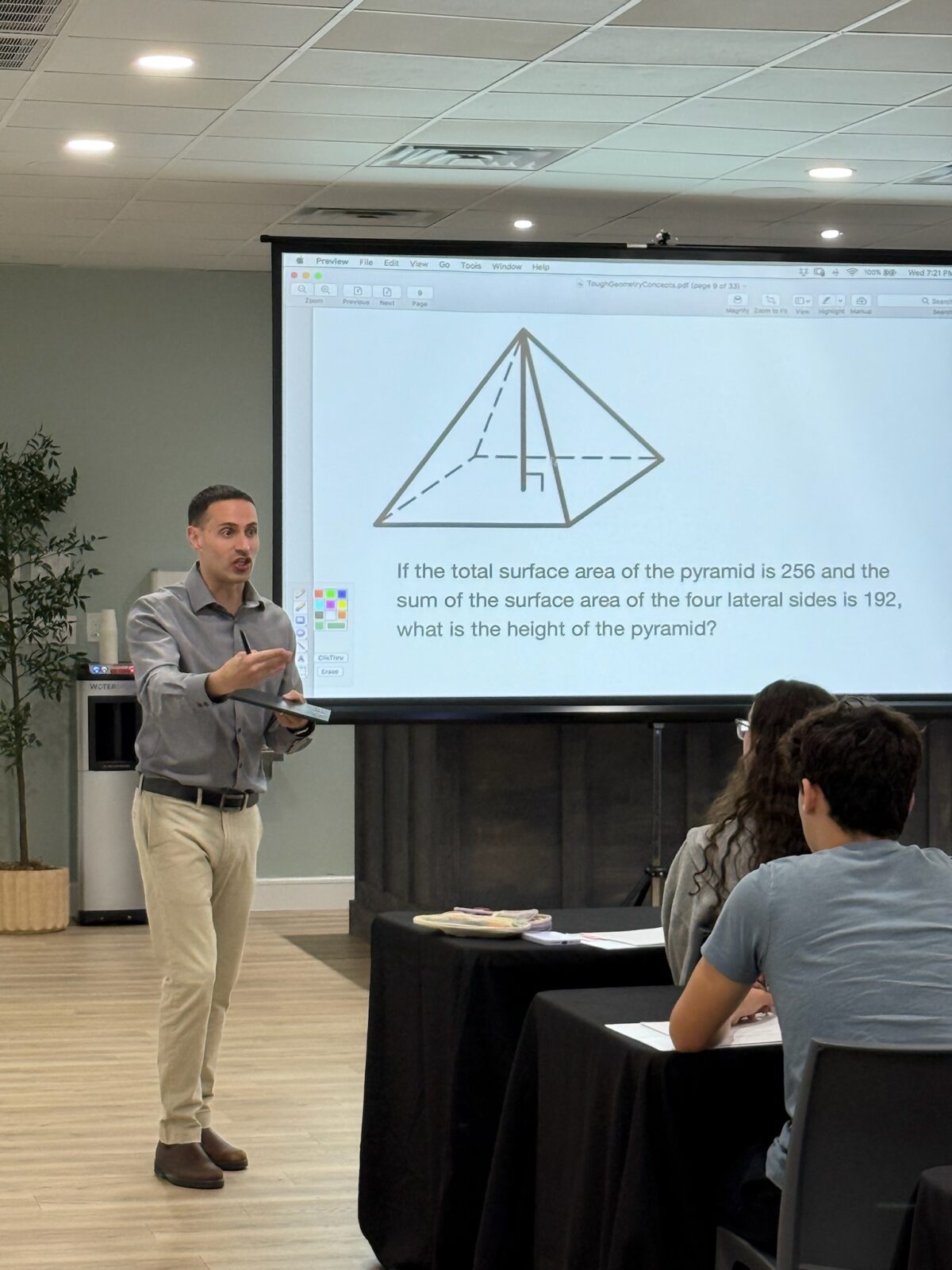
Every class is taught by Jake.
The approach you’ve been reading about is the one students actually experience in class.
I have been teaching SAT prep for more than 20 years, have worked with thousands of students, and have personally taken the SAT more than 100 times.
But the number of years and tests matters less to me than what has happened during them.
Every class has given me another opportunity to notice how students think. Every SAT has given me another opportunity to study how the exam works. Over time, I have kept finding small ways to make an explanation clearer, a strategy more useful, or a decision process more precise.
Most of those improvements have not been dramatic breakthroughs.
They have been small refinements.
Another two percent better.
Over more than two decades, those refinements compound.
And there is no handoff from the person who developed this approach to another instructor. I teach every Jake SAT Prep class myself.
That means the person teaching your child is also the person answering your questions, refining the program, and continuing to study the SAT long after most people would probably have had enough of it.
What class is actually like
Students do not come to class just to watch me work through a list of SAT questions.
They practice between classes, bring in the questions that gave them trouble, and we use those questions to figure out what was really happening.
Sometimes the most useful question is not:
“Why is B right?”
It is:
“I understand why B is right. Why is C wrong?”
That distinction matters.
A tempting wrong answer usually failed for a reason. A difficult math problem usually contained some clue about how to begin. A student who got stuck often had more useful information than they realized.
We talk about those moments.
And in a group class, one student’s question can help everyone else. Another student may have made the exact same mistake, been torn between the same two answers, or struggled with the same idea without knowing how to put it into words.
Students’ different points of confusion become part of the curriculum.
That is one of the reasons a group class can be so valuable. Students get answers to their own questions, but they also learn from the questions and thought processes of everyone around them.
In person or on Zoom
The curriculum and teaching are the same. In-person classes provide more built-in accountability. Zoom offers the convenience of joining class from home.
Questions are encouraged
Students can ask about the specific problems, choices, or ideas that confused them.
Work between classes
Students practice what we are learning so that class time can be spent digging into the places where they actually got stuck.
Miss a class?
Students can usually attend another class that week when space allows or use a recording to catch up.
What families say
The best way to understand the experience is to hear from the students and parents who have been through it.
“This isn’t just a class of sitting there & taking exam after exam. He gives the students the analysis to understand the nuances…”
Sandra Noonan Brew, Parent
“I loved how much experience he has with the SAT… which allowed him to identify patterns and teach us those patterns to do great on test day.”
Alexandros Theodossis, Student
“After having a previous experience with another SAT company, I was blown away by Jake’s level of investment, accessibility and preparedness. This is not something thrown together and repeated robotically.”
Joanna Santoli, Parent
“My daughter walked in to SAT cool, confident and well prepared. There were no surprises during the test and she walked out self-assured that she had done her best.”
Lisa Thornton, Parent
A few student-reported results
1420 → 1590
1350 → 1540
1180 → 1520
Selected results reported by students in public Google reviews. Individual results vary.
Ready to get started?
View the upcoming SAT programs, compare dates and locations, and choose the class that works best for your family.
Not sure when to begin?
If you are unsure about timing, which test date your child should target, or how preparation should fit into the rest of the school year, ask me.
I am happy to help you think through the options.